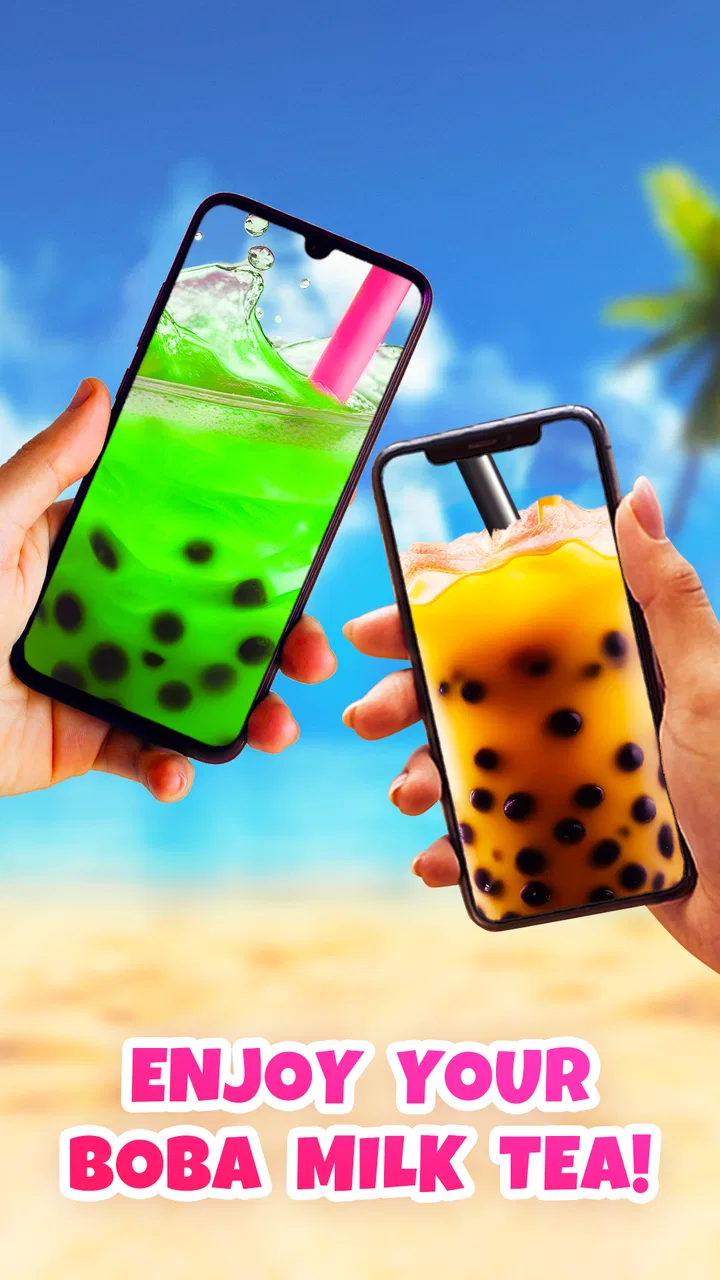
Boba Tea Smoothie Drink Joke
- 4.5
- Rating
- 10.00M
- Installs
- Free
- Price

 Analysis by App-foxy
I picked up Boba Tea Smoothie Drink Joke expecting a quick, playful drink-making game, and that is exactly where it fits best. It is a casual simulation from DobroGames Global that turns the idea of mixing boba tea into a small phone activity. The appeal is immediate: instead of managing a café, balancing a budget, or learning a complicated recipe system, I can focus on the visual and tactile fantasy of preparing a colorful milk tea drink.
The game is free to start, carries a Teen content rating, and has reached more than ten million installs. Its average score sits at 4.5 from roughly one hundred twenty-two thousand ratings, which gives a useful picture of its broad appeal without making it seem like a deep management simulator. I would describe it as a lightweight time-killer for people who enjoy simple food-and-drink interactions, not as a substitute for a full restaurant game.
What the first few minutes are really like
The early goal is refreshingly clear: make a boba-style drink and enjoy the process of turning separate ingredients into something that looks ready to serve. I did not have to study a long tutorial or understand a complicated economy before getting started. That low barrier matters because this is the kind of game I would open while waiting for an appointment, taking a short break, or letting a podcast play in the background.
You May Also Like

 Blood Strike: 2.5 Anniversary
Blood Strike’s Loadouts Turn Every Drop Into a Tactical Gamble
A close look at Blood Strike’s custom loadouts: how fast access to signature weapons reshapes its battle royale rhythm, rewards preparation, and narrows the gap between fights.

 Pandora - Music & Podcasts
Pandora’s Music Is Easy to Start, but Harder to Recover
Pandora’s strength is its low-effort path from a seed to a station. Its weak spot is how much confidence it asks you to place in connection, setup, and quiet recovery.

 8 Ball Pool
 Is Built on Rivalries, Rematches, and Routine
A close look at the rivalries, rematches, shared routines, and unanswered safety questions that turn a quick pool match into a persistent mobile community.

 Samsung Music
’s Quiet Strength Is Playing What You Already Own
Its reach comes less from spectacle than from dependable access to a personal library. That simplicity is both the app’s strongest retention engine and its ceiling.

 AccuWeather: Weather Radar
AccuWeather Review: A Quick, Clear Forecast for Everyday Decisions
For everyday plans, the best forecast is the one you can understand quickly. AccuWeather makes rain timing, radar, and local conditions easy to act on, with a few trade-offs.

 Hill Climb Racing
Why Hill Climb Racing Still Turns Crashes Into One More Run
A tiny car, a bumpy hill and one more upgrade: Hill Climb Racing keeps resurfacing because its simple chaos makes every near-miss feel personal.
More From Our News Desk



The drink theme gives the opening a stronger identity than a generic mixing game. Boba tea has recognizable visual ingredients, and the combination of tea, milk, ice, color, and tapioca pearls creates a satisfying sense of completion. Even when the interaction is simple, the final appearance gives me a small reason to finish the sequence rather than abandon it halfway through.
One useful way to approach the opening is to treat each drink as a short creative exercise rather than a challenge that must be optimized. I found more enjoyment in paying attention to the order and appearance of the mixture than in trying to rush. That makes the game suitable for younger players who like pretend food preparation, while the Teen rating is still worth keeping in mind for families deciding whether it is appropriate for a particular child.
The early loop also answers an important practical question: can someone play without committing to a long session? Yes. The format is built around brief interactions, so I never felt that closing the game would ruin a carefully planned campaign. That is a strength for casual players, although it also means the opening may feel too slight for anyone looking for a substantial story, a demanding objective, or a long-term café to build.
Simple goals, but not a conventional café career
Players coming from restaurant simulations should adjust their expectations. There is no reason to approach this as a business-management experience where staffing, supply chains, customer queues, and profit margins drive every decision. The central satisfaction comes from preparing the drink itself. In my view, that makes the game more approachable, but it also limits the sense of ambition behind each session.
The most effective early goal is therefore personal: make a drink that looks and feels complete, then decide whether the interaction was relaxing enough to repeat. That sounds modest, but it is honest. The game works when I want a playful miniature activity, not when I want a structured career path with a constant stream of meaningful decisions.
A small but important tip is to avoid judging the experience after only one rushed attempt. The appeal is in the repeated rhythm of handling a drink from start to finish. If I tap through everything as quickly as possible, the game can seem empty. If I slow down and treat the preparation as the main event, the visual theme has more room to work.
How progress feels when the novelty settles
The progress signals in a game like this are less about mastering a complex system and more about seeing a finished result. The completed cup is the clearest reward: ingredients come together, the drink changes visually, and the preparation reaches a natural endpoint. That kind of feedback is immediate, which helps the game feel responsive even when the broader progression is light.
I would not recommend installing it while expecting a deep unlock tree or a competitive ladder. The verified current version is 2.8.7, but a version number should not be mistaken for evidence of a large progression structure. What matters here is the repeated satisfaction of making another drink and noticing how much interest the presentation still holds after the first few attempts.
This is where the game’s retention design feels both effective and limited. The colorful drink concept gives me a reason to return for another short session, especially when I want something less demanding than a puzzle or action game. However, the motivation is mostly sensory and routine-based. Players who need explicit missions, increasingly valuable rewards, or a strong sense of character development may run out of reasons to continue sooner than expected.
I also think the game benefits from being treated as a reset-friendly experience. I can leave it and return without needing to remember a complicated plan. That is useful on a phone, where interruptions are normal. The trade-off is that the lack of a demanding long-term objective can make the sessions blend together. It is easy to enjoy a few rounds; it is harder to promise that every return will feel meaningfully different.
What counts as an unlock or reward here
The editorial question about unlocks needs a careful answer. The game’s strongest sense of advancement comes from completing the preparation sequence and seeing the drink take shape, rather than from a clearly defined management campaign. I would not buy it expecting a large collection of permanent upgrades or a carefully staged professional journey. Its reward language is closer to “make and admire another drink” than “build toward a major milestone.”
That can still be enough for a certain kind of player. Someone who enjoys drink aesthetics, casual role-play, or short repetitive tasks may find the loop pleasantly calming. Someone who asks, “What do I unlock next, and how does that change the way I play?” should be more cautious. The game’s charm is front-loaded in the theme and interaction, so its long-term value depends heavily on how much repetition the player personally enjoys.
My practical advice is to use it as a small break rather than a primary game. A few minutes of drink preparation can be a nice change from scrolling, especially when I want something interactive but not mentally exhausting. If I were choosing one game to occupy a long journey, I would prefer a title with clearer objectives and more substantial progression.
Difficulty, pacing, and the point where repetition appears
The difficulty curve is gentle. This is not a game that asks me to memorize complicated rules, react to fast enemies, or solve increasingly difficult logic problems. Its challenge comes from following the preparation flow and staying engaged with a deliberately simple activity. That makes it welcoming, but it also means the sense of improvement is subtle.
I see that as a deliberate pacing choice rather than a flaw by itself. A demanding curve would conflict with the relaxing drink-making premise. The game is at its best when the player wants control without pressure. There is enough structure to make the action feel like a game, but not so much that a mistake turns a short break into a frustrating session.
The downside is that players who need escalating difficulty may feel the pace flatten out. In a traditional simulation, progress might introduce busier customers, tighter budgets, more complex recipes, or tougher service demands. That type of escalation is what keeps a management game moving forward. Here, the focus remains much narrower, so the experience can become repetitive once the novelty of the boba theme has been absorbed.
I would especially avoid recommending it to someone who dislikes repeated preparation animations or simple touch-driven routines. The game does not seem designed to surprise the player with a dramatically changing challenge every few minutes. Its strength is consistency. If I want a predictable activity that I can pick up and put down, that consistency helps. If I want constant discovery, it works against the game.
Why the slow pace works for some players
The relaxed pacing makes sense in everyday use. Imagine sitting on a train with only a short stretch of time before the next stop. A complex simulation would be awkward because it might require planning, while an action game could be difficult to play around interruptions. This drink-making format is easier to pause mentally and physically. I can complete a small activity, put the phone away, and move on without feeling that I abandoned a larger strategy.
It can also suit players who enjoy looking at the result of a process. The drink is not just a score on a screen; it is the visual endpoint of the interaction. That gives the game a little more personality than a bare tap-to-complete task. I would still call the challenge mild, but mild challenge is exactly what some people want after a tiring day.
There is a trade-off in that comfort. Because failure does not appear to be the main attraction, the game may not create the tension that makes other simulations addictive. A restaurant-management alternative is better for players who want decisions to have economic consequences. A cooking game with timed orders is better for players who enjoy urgency. This one is better when the preparation itself is enough.
Retention pressure and the role of optional spending
The game’s retention pressure is relatively soft compared with titles built around constant competition or difficult daily targets. I do not feel pushed toward a long session simply because I started one. That is a positive quality for casual use. At the same time, soft retention means the game has to rely on the pleasantness of its theme and the satisfaction of repeating the drink-making loop.
There are in-app purchases priced from $0.99 to $5.49 per item. Since the game is free, this is the main point where a player should make a conscious choice. I would begin without spending anything and first decide whether the basic preparation loop remains enjoyable after the initial novelty. Paying can make sense for a player who already knows the game is a favorite, but I would not treat purchases as a requirement for testing whether the concept works for me.
That approach is especially important because this is a narrow simulation. In a large strategy game, optional purchases might be weighed against a wide range of systems and many hours of play. Here, the decision is simpler: do I enjoy making boba drinks often enough to justify spending on extras? If the answer is no, keeping the experience free is the sensible option.
Another practical consideration is the difference between a game that encourages return visits and one that earns them through depth. This title leans toward the first category. Its visual premise can draw me back when I want a familiar activity, but it does not automatically solve the problem of repetition. I would not install it for a reward schedule alone; I would install it because the drink theme sounds appealing.
Who will stay, and who will move on
I think the best audience includes casual players, fans of food-themed games, and people who like uncomplicated simulations with a clear visual outcome. It may also work for someone looking for a low-stress phone activity that does not demand constant concentration. The free entry point makes it easy to sample, and the broad install base suggests that the basic idea has connected with many mobile players.
I would point elsewhere if the goal is a serious café simulation. Players wanting recipes with strategic consequences, customer management, expansion decisions, or a strong economic layer will probably find a more traditional restaurant title more rewarding. I would also choose a puzzle or action game for someone who measures fun through difficult wins rather than through a completed preparation sequence.
Parents should pay attention to the Teen rating before handing the phone to a younger child. The drink theme may look harmless at first glance, but the age classification is the relevant guide for deciding whether it fits the intended player. I would also remind children that optional purchases exist, even though the game itself is free to download.
Device expectations and everyday usability
The minimum operating-system requirement is Android 7.0, so the game is positioned to work on a wide range of older Android devices as well as newer phones. That makes it more approachable than a visually demanding simulation that requires recent hardware. Still, the actual comfort of play will depend on the phone’s screen, responsiveness, and general condition, especially because the experience relies on touch interaction and visual presentation.
I would use headphones only if I personally enjoyed the game’s sound design; they are not essential to understanding the central activity. The important part is being able to see the mixture clearly and perform the preparation steps comfortably. On a small or dim display, the visual pleasure of the drink theme may be reduced, which is worth considering before deciding whether this is the right casual game for an older handset.
The title was released on February 9, 2017, and its continued availability shows that it has remained part of the mobile game landscape for years. I would not interpret that age as a promise of modern simulation depth. Instead, it tells me that the straightforward concept has lasting casual appeal. The current version, 2.8.7, is the one I would look for when installing, since staying current is generally the safest way to experience the maintained release.
One useful workflow is to play in short, intentional sessions: open it when I want a visual break, complete a drink, and stop before the repetition becomes tiring. That keeps the game’s strongest quality—its simplicity—from turning into its most noticeable weakness. Trying to force a long marathon session is, in my opinion, the quickest way to notice how limited the broader progression feels.
My progression verdict
The game sustains interest through a pleasant preparation loop, not through deep escalation. Its early goal is easy to understand, its progress signal is the finished drink, and its difficulty stays gentle enough for relaxed play. That combination is coherent. I never felt that the game was pretending to be a large management simulator when its real purpose was a small, colorful interaction.
The limitation is equally clear. Once the novelty of making boba drinks settles, the game needs the player to enjoy repetition for its own sake. The challenge does not appear to be the main engine, and the long-term unlock structure is not the reason I would recommend it. Players who need a strong campaign, demanding objectives, or a constantly expanding system should choose another simulation.
For me, the best recommendation is conditional but positive: try it if you want a free, casual boba tea activity on your phone and are comfortable with light progression. Start without buying anything, play it during short breaks, and judge whether the preparation loop remains satisfying after the first few sessions. If it does, the game has found its audience. If I wanted strategic planning or a more rewarding sense of advancement, I would move to a full café-management alternative instead.
Overall, DobroGames Global has made a focused simulation that understands its own strongest idea: the simple pleasure of preparing a colorful milk tea drink. It is approachable, easy to revisit, and well suited to brief moments when I want something gentle. I would not call it a deep game, but I would recommend it to a friend who enjoys food-themed mobile experiences and wants a small, low-pressure activity rather than a demanding virtual business.
FAQs for Boba Tea Smoothie Drink Joke
01What is Boba Tea Smoothie Drink Joke, and how does it work?
Boba Tea Smoothie Drink Joke is a fun simulation app that allows users to create virtual bubble tea drinks. It’s designed for entertainment purposes, mimicking the experience of mixing ingredients and shaking the drink. Users can enjoy the playful graphics and interactive features without making a real mess.
02Is Boba Tea Smoothie Drink Joke suitable for all ages?
Yes, the app is designed to be family-friendly and suitable for all ages. It’s a lighthearted and humorous app that doesn’t contain any inappropriate content, making it perfect for kids and adults who enjoy playful simulations and love bubble tea culture.
03Are there any in-app purchases or ads in Boba Tea Smoothie Drink Joke?
The app is free to download, but it may contain ads and optional in-app purchases. These purchases typically allow users to unlock additional features or remove ads. Checking the app description on the download page will provide more specific details on what to expect.
04Does Boba Tea Smoothie Drink Joke require an internet connection?
Boba Tea Smoothie Drink Joke can be enjoyed offline, making it convenient to use without a constant internet connection. However, if the app includes ads or additional downloadable content, an internet connection might be necessary to access those features.
05How can I download Boba Tea Smoothie Drink Joke on my device?
You can download Boba Tea Smoothie Drink Joke from both the Google Play Store for Android devices and the Apple App Store for iOS devices. Simply search for the app by name, and follow the prompts to install it onto your device. Make sure your device meets the app's compatibility requirements.
Pros
- Fun and interactive design
- Customizable drink options
- User-friendly interface
- Engaging sound effects
- No in-app purchases
Cons
- Limited drink recipes
- No multiplayer mode
- Repetitive gameplay
- No offline mode
- Ads can be intrusive

Boba Tea Smoothie Drink Joke
Gallery